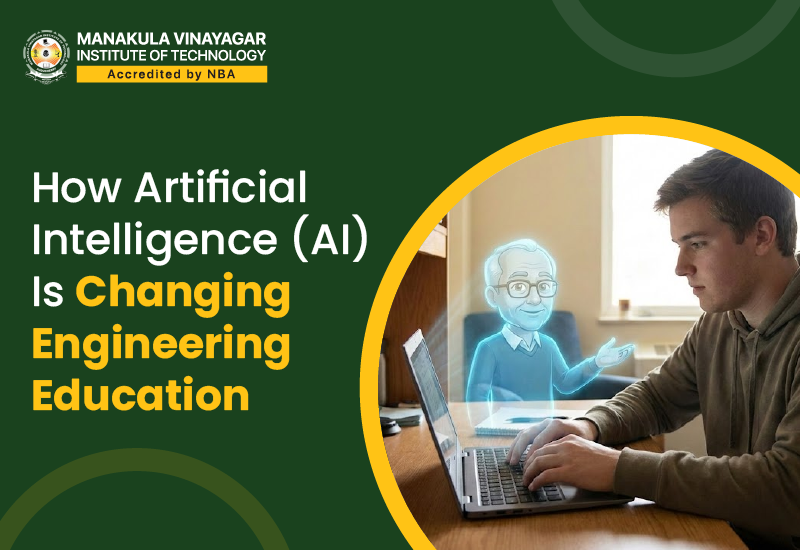
AI is changing engineering education. We’re teaching engineering in a way that helps students learn, practise, and get ready for what the industry needs.
AI helps engineering education through custom learning, changing tests, online labs, and job skill programmes.
This post talks about AI and engineering education. It also talks about what MVIT is doing to help make smart engineers set for the future.
Introduction
AI isn’t just for tech companies anymore. It’s a big deal for change in all areas, including learning.
AI in engineering education is helping come up with new ways to teach and making learning easier and more flexible.
With engineering changing and new tech like automation, data crunching, and machine learning, our education has to change, too.
In this post, we’ll talk about how AI can really change engineering education, why it matters, and what it means for engineers.
What AI Means for Engineering Education
AI in engineering education means using smart tech like machine learning, data analysis, and online help to help with teaching and learning.
Looking at data helps these tools figure out how students act, how they do in class, and how they learn.
Analysis by these tools enables them to interpret data on students’ behaviour, performances, and learning patterns.
While traditional models of education are concerned, we can certainly aim for a more personal and result-oriented learning process with artificial intelligence systems and their applications.
Personalised Learning
Every engineering student differs in how they learn. While some engineering students learn theory quickly, others learn by implementation. These students face difficulties in conventional classroom teaching.
With the help of learning platforms based on artificial intelligence, we can personalise learning according to their needs. Students can benefit from these learning platforms and perform well in complex subjects like engineering.
Such an approach not only enhances understanding but it also enhances confidence and motivational levels among learners.
Smart Assessments and Instant Feedback
In engineering education, the issue of assessment is paramount, but in conventional examination settings, there has been a lack of feedback. AI has introduced the aspect of real-time feedback.
Artificial intelligence-based evaluation tools can grade assignments and coding exercises automatically while offering extensive information on the performance of the students.
These features of AI allow the students to know the flaws in their performance and make way for continuous improvement rather than relying on the semester-end result.
AI-aided analytics assist teaching professionals like us in analysing learning patterns and tailoring our teaching methodologies.
Virtual Labs and Simulations
The traditional lab environment may be constrained because of costs and safety concerns, while AI simulations may be the next level that needs to be reached.
Using intelligent simulations, students can design circuits, examine the mechanics of a system, carry out experiments, and interpret results within the virtual environment.
Intelligent simulations allow the students to simulate various engineering tasks, practise repeatedly without any consequences, and also allow the students to experiment and innovate. At MVIT, the students develop conceptual knowledge and can experiment and innovate.
Enhancing Student Engagement and Interaction
AI-based learning platforms have become essential for engineering students. In a survey, it is found that almost 92% of students are using AI tools for their work. This is also to make learning more interactive.
These tools help students in their studies, respond to their queries, and help them in their coursework.
At MVIT, the adaptive learning assignments and the creation of an intelligent assistant have started reflecting this shift. Incorporation of hands-on AI tools into engineering coursework has also been attempted.
Build Industry Skills
The field of engineering is quickly incorporating technology like AI in areas like manufacturing engineering, electronics engineering, infrastructure engineering, computer science engineering, and communication technology. Therefore, there is a growing demand from employers for candidates who have knowledge of concepts like AI.
Through AI in engineering education, we teach students how to make predictions from data, automate tasks, and make intelligent decisions.
Indeed, engineering education should move from the realm of textual mastery to that of future-proof skill development.
Helping Teachers and Making Teaching Better
It helps teachers by giving them what they need. Smart systems deal with repetitive stuff like taking attendance and grading papers. This frees teachers up to lead and come up with cool, innovative ideas.
The insights provided by AI help educators in understanding the behaviour and engagement levels of the students. These insights help us in developing effective teaching methods.
Encouraging Collaborative and Interdisciplinary Learning
Engineering problems are not always solved in isolation; they can be solved easily with collaboration. Platforms that use AI among students foster this through group projects and participation in peer-to-peer and interdisciplinary research.
They will be able to work in close coordination with students from other engineering streams with the help of intelligent tools, which would assist them in communication, sharing of ideas, and project management.
It would help students get better prepared for the practical world, where engineers have to work in teams.
Challenges in Integrating AI into Engineering Education
Whereas the advantages of AI are massive, it needs to be implemented in the right way.
Implementation challenges associated with AI in universities include data privacy issues, utilization of AI for good purposes, and dependence on staff training by AI-powered systems.
We strongly believe in collaboration between human intervention and AI to achieve this balance.
MVIT: Shaping Intelligent Engineers for the Future
It is our endeavour at MVIT to impart education in tune with technological advancement. We firmly believe that intelligent systems, decision-making through data, and innovation constitute the tripod on which future engineering rests.
We inculcate modern methods of learning, upgrading ourselves with the changing trend in technology. Thus, we fully equip our students to excel in an AI-dominated environment.
Instead, our emphasis is on building strong foundations, exposure, and skill development for life that will enable our students to have successful careers.
To wrap up
AI in engineering education is revolutionising; not only is it being used for adaptive learning and assessment, but it is also being used for virtual labs and competency-building aligned with industries.
At MVIT, we see an opportunity in the role of AI in engineering education. We can use AI in engineering education to enable the generation of engineers that can effectively adapt to the future shaped by technology.
As we use AI technology in engineering education, we can produce engineers that can drive the next technological revolution.
Frequently Asked Questions
1. What does the term AI bring to engineering education?
AI in engineering includes using AI technology to provide personalisation, enhance assessment, increase training and development, and match education with industry.
2. In what ways does AI help engineering students?
AI enables students to learn at their pace, get instant feedback, simulate learning practises, and develop skills that are relevant to their chosen industries.
3. Does AI replace teachers in engineering colleges?
No. AI helps teachers in automating tasks, while teachers are still essential in mentorship.
4. How is AI important for Future Engineers?
AI capabilities have assumed immense importance due to the growing demand for automation, data analysis, and intelligence in all fields of engineering.
5. In what ways is MVIT responding to education through AI?
The primary focus of MVIT lies in modern methods of learning, application-based learning, and future-ready curriculums, as engineering technology is soon going to be AI-integrated.