The best engineering courses after 12th that suit us the best depend on our own interests, talents, and career objectives.
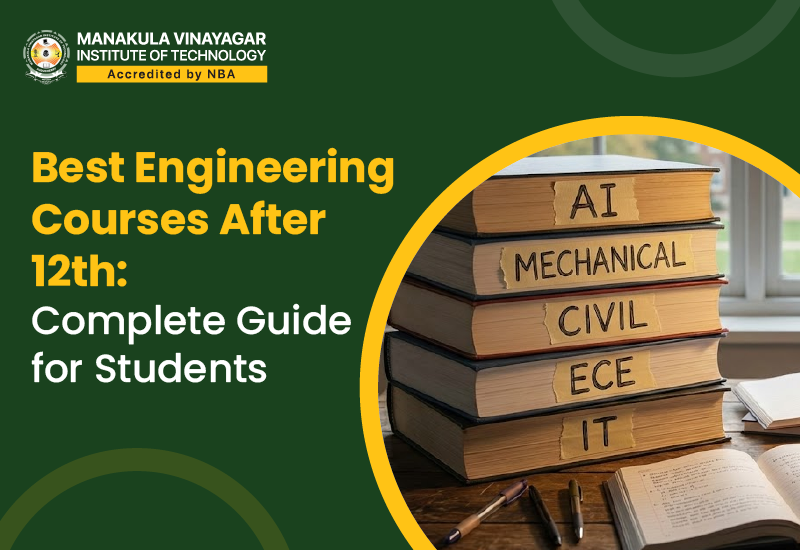
Some popular courses include Computer Science, AI, mechanical, civil, electrical, and electronics. New interdisciplinary areas that emerge through the intersection of technology and innovation.
This blog will give you the complete details of these courses.
Introduction
Picking the best engineering courses after 12th is perhaps the biggest academic choice that we make.
Engineering is one of the most preferred streams that we choose as a career because of its expertise and the stability of a career as an engineer over time.
The increasing number of engineering streams nowadays has turned picking an engineering stream into a daunting task.
This blog will discuss the top engineering courses available after completing the 12th standard, the areas of study, and the skills.
This will help you to know about each field of study and plan accordingly based on your skills and interests.
Why Choosing the Right Engineering Course Is Important
Engineering is not limited to acquiring an education; it sustains our work lives for decades.
The branch that helps decide the sectors in which we work and the skills we develop, or rather get exposed to.
Choosing the appropriate course helps us to:
- Stay motivated throughout our studies
- Acquire relevant, industry-specific skills
- Enhance placement opportunities and career development
- Take advantage of future technological advances
As a consequence, careful attention must be paid to course choice, which forms the basis for a successful career as an engineer
Eligibility Criteria for Engineering after 12th
For studying engineering in India, we will require:
- Passing Class 12 examination with physics, chemistry, and mathematics
- Minimum passing marks as decided by an institute & exams
- Qualification in examination like JEE mains, state level CET, or entrance examinations
After fulfilling the eligibility criteria, we have various options at our disposal to choose from among engineering disciplines.
Best Engineering Courses After 12th
While discussing the best engineering courses after 12th, one always has to veer away from popularity. And get into the gist of what each branch offers as far as learning and career growth are concerned.
- Computer Science Engineering
Computer Science Engineering is one of the most sought-after streams of engineering because it is indeed the backbone of the information and communication technology industry that drives the current economy.
What we study:
The subject teaches us extensive knowledge about computing fundamentals in detail. The course encompasses programming languages such as Python, Java, C, and C++.
Data Structures, Algorithms, Operating Systems, Database Management Systems, Computer Networks, and Software Engineering Basics.
Skills we develop:
- Very strong logical reasoning abilities
- Advanced programming and writing code skills
- Expertise in problem solving, debugging, and designing systems
By completing the CSE course, we can become software developers, full-stack programmers, data analysts, cybersecurity professionals, cloud architects, and system engineers.
Today, TCS and Infosys, Google, and Amazon hire Computer Science engineers in large numbers for software development, cloud computing, and cybersecurity. According to reports, Computer Science and IT together make up about 40% of the engineering placements in India, making it one of the most sought-after branches.
- Artificial Intelligence and Machine Learning
Artificial Intelligence and Machine Learning is the right engineering choice after class 12. These are future-focused areas, where the application is to build intelligent systems with data learnability and decision-making capabilities.
What we study:
The subjects that are being studied within this course include machine learning algorithms, neural networks, computer vision, and big data analysis. Math, statistics, and probability are very useful while trying to understand how these systems work.
Skills we develop:
- Data modelling
- Interpretation
- Predictive analysis
- Algorithmic thinking and optimisation
There is a great demand for AI and ML engineers in the roles of data scientists, AI engineers, ML engineers, robotics engineers, and automation experts.
- Information Technology
Information Technology is concerned with the application and management of computing systems in an organisation.
What we study:
The IT syllabus consists of web technologies, software development, network administration, cloud infrastructure, database management systems, and information security.
Skills that we develop:
- System and network administration skills
- Capabilities in web and application development.
- Information technology infrastructure planning and maintenance
IT graduates can also be employed in roles such as system administrators, web developers, IT consultants, software testers, network engineers, and technical support professionals.
- Mechanical Engineering
Mechanical engineering involves a specific set of operations.
What we study
We learn about thermodynamics, fluid mechanics, manufacturing processes, the basics of robotics, and industrial engineering.
Skills we develop:
- Designing and analysing mechanical systems
- Technical and Analytical Problem Solving
- Comprehension of machines, tools, and production systems
Mechanical engineers are employed in the automotive, robotics, energy, and heavy engineering sectors as design engineers, product engineers, quality engineers, or maintenance managers.
- Civil Engineering
The interest of Civil Engineering is in designing, developing, and managing infrastructure for economic growth and living.
What we study:
It covers structural engineering, construction planning and management, geotechnical engineering, transportation engineering, environmental engineering, and surveying.
Skills we develop:
- Structural planning, analysis, and design
- Coordination of projects and site management
- Engineering judgment and decision-making in practice
Various jobs can be done by civil engineers in the capacity of a site engineer, structural consultant, construction manager, urban planner, project engineer, and government engineer.
- Electrical Engineering
Electrical Engineering is concerned with the design, analysis, and application of electrical power systems, which are the driving technologies behind modern infrastructure, industries, and other applications.
What we study:
The major topics we cover are electrical circuits, electricity generation and distribution, electrical machines, instrumentation, and protection systems.
Skills we develop:
- Electric system design and analysis
- Fault detection, troubleshooting, and maintenance
- Energy management and optimisation of efficiency
The graduates are employed in power stations, companies involved in renewable energy, manufacturing units, and infrastructure projects, working as electrical engineers, power system engineers, and energy consultants.
- Electronics and Communication Engineering (ECE)
Electronics and Communication Engineering bridges the concepts of electronics with the communications solutions that make connectivity possible.
What we study
The syllabus comprises microelectronic devices, digital electronics, microprocessors, embedded systems, communication networks, signal processing, VLSI design, and wireless communication.
Skills we develop:
- Design, testing, and analysis of circuits
- Embedded programming & hardware integration
- The process involving embedded
- Communication system planning and optimisation
- Communication systems can vary
The job opportunities of ECE students exist in telecommunications, defense services, electronics manufacturing, semiconductor industries, the development of embedded systems, and research institutions.
- Emerging and Interdisciplinary Engineering Courses
Today, engineering education has incorporated transdisciplinary programmes that bring together different areas of expertise to solve a specific industry problem.
Skills we develop:
- Data Science engineering
- Robotics & automation
- Internet of Things (IoT)
- Mechatronics engineers
These programmes bring together software and hardware, analysis, and automation to enable and prepare us for specific roles within intelligent manufacturing, artificial intelligence systems, and more.
How We Can Choose the Best Engineering Course After 12th
The right engineering course should be chosen after much deliberation rather than by going with the wind of fashion.
- Evaluate Our Interests and Strengths
We are to identify subjects we like and understand because a great interest often goes hand in hand with good learning results and career satisfaction.
- Skill Requirements Understood
Each branch requires specific kinds of skills; some require coding and logic, whereas others involve design thinking or practical skills.
- Contemplate Higher Studies and International Exposure
Some branches offer more opportunities in postgraduate studies, research, or even international careers.
- Choosing the Right Institution
The key factors that will mark our engineering journey will be in relation to the faculty’s quality, infrastructure, industry exposure, and placement support.
Developing Future-Ready Engineers at Manakula Vinayagar Institute of Technology
At Manakula Vinayagar Institute of Technology, students are encouraged to opt for some of the best engineering courses after 12th qualifying examination.
The college focuses on a sound education, exposure, and alignment of education according to the industry.
Manakula Vinayagar Institute of Technology has updated labs, qualified faculty, and a course of study updated to keep pace with increasing technological requirements.
Along with the technological awareness, the creativity and problem-solving skills are also to be developed by the students themselves.
To Sum Up
There are diverse career options available to students and one of them is the best engineering course after 12th for students.
While Computer Science dominates the digital sector, traditional fields like Mechanical and Civil remain relevant for long-term infrastructure roles.
The most Suitable engineering streams for students after 12th class would serve their interests and needs.
Frequently Asked Questions
- What are some of the best engineering courses after 12th?
The most sought-after engineering courses after 12th grade are Computer Science, Artificial Intelligence, Information Technology, Electronics, and other engineering disciplines.
- Is Computer Science Engineering a good career path?
Of course, there is excellent job potential and demand, coupled with assured long-term growth opportunities available from the Computer Science Engineering courses.
- Is the education in engineering offered by the ‘new wave’ of engineering schools
The new streams are based on modern technologies, while traditional streams provide flexibility and job security.
- What entrance exams are required for engineering after 12th?
JEE Main, JEE Advanced, and CETs, as well as other university-specific entrance examinations, are some common entrance exams.
- How big of a role does college choice play in engineering?
The college choice is very important because it influences the quality of education and industry interaction, placement, and overall development.
- Can we change specializations once we join engineering?
Switching can occur in institutions, but it is always recommended that one choose wisely from the start to prevent any academic problems.